Showing posts with label Adventure. Show all posts

Saturday, June 6, 2026

A Two-Hour Safari

Not every adventure needs a week of leave, a fully packed pannier setup, or a destination hundreds of kilometres away. Sometimes, the perfect escape is sitting right on your doorstep.

I recently discovered exactly that on a short circular ride that I can only describe as a “Two-Hour Safari”, a scenic backroad route winding through game farms, rolling hills, quiet gravel roads, and even a few small mountain passes. It is the kind of ride that reminds you why motorcycles and backroads belong together.


The route passes the impressive Hartbeeskuil Dam, and after the recent rains, the dam is an incredible sight. Filled right to the brim, the water stretches across the landscape like an inland sea, reflecting the clouds and mountains around it. It is worth stopping just to take it all in for a few minutes.

But the real magic starts once the road enters the surrounding game farm areas.


Within minutes I started spotting wildlife everywhere. Wildebeest and Eland grazed calmly in open fields while Zebra moved between the bushes. Springbuck scattered across the plains and massive Giraffe stood watching from a distance. Waterbuck appeared near the wetter areas and Ostriches casually wandered alongside the road. At times it felt less like a normal ride and more like a proper safari, just without the game viewer and khaki uniforms.


Then came the part that really got my attention.


For roughly six kilometres, the road runs directly through the spectacular Gondwana Private Game Reserve. Unlike many reserves where dangerous animals are kept behind separate fencing, Gondwana has free-roaming Lion, Buffalo, Elephant and Rhinoceros in certain areas. Suddenly the ride became a lot more exciting.

I must admit, I became slightly nervous.


Not long after entering the reserve section, I encountered some Elephants near the road. Seeing animals like that from the saddle of a motorcycle changes your perspective very quickly. You suddenly feel very small and very exposed. Add to that the antelope and other game occasionally running ahead of the bike on the road itself, and your senses become fully switched on.

It was thrilling, slightly intimidating, and absolutely unforgettable.


What makes this route so special is how accessible it is. You do not need complicated planning, expensive bookings, or days away from work. It is the perfect micro-adventure, a quick break from routine that still delivers scenery, wildlife, gravel roads, and genuine adventure.


Sometimes two hours is all you need to reset the soul.

And sometimes, the best safari is the one hiding just beyond your hometown.


Download Route HERE

Distance: 53km

Travel Time: 2 hours.

Road Surface: Mostly gravel with loose sections, can be slippery when wet.

Saturday, March 14, 2026

Scenic Rides & Drives: Bloukrans Pass

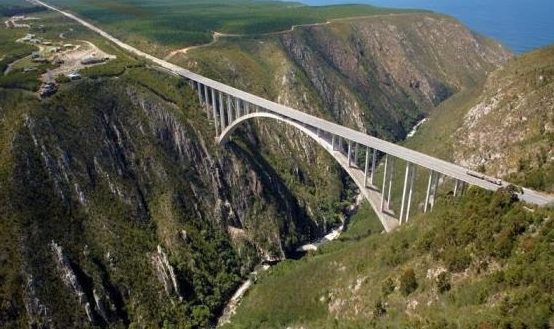
Say “Bloukrans” and most South Africans immediately recognize the name. This is the spot where the adventurous and somewhat crazy do what is reputed to be the highest bungee jump in the world. It is an adrenaline-pumping jump into the gorge and to the river a whopping 216 meters below.


Aerial view of the new N2 bridge over the Bloukrans gorge / Photo: Panoramio

Somewhat forgotten though, is that Bloukrans has something else to offer, something that should be an even bigger draw card for tourism, but is sadly neglected. The absolutely spectacular Bloukrans Pass. The old, original pass.

I rode this pass with my motorcycle about two decades ago and even though it was badly in need of maintenance even then, the sheer beauty of this road took my breath away. Because of the neglect and lack of maintenance the road was closed soon after and blocked off on both ends with a large heap of gravel.

Fast Forward to 2024 and the Western Cape Government decided to repair the pass, all the way to the Western Cape Province border, which, sadly, is only about half of the pass. It does present a wonderful opportunity though to access the pass and enjoy is splendour, without having to negotiate a lot of traffic as the Eastern Cape side is still blocked off (as of December 2024).

When the government first started considering a coastal road between Port Elizabeth and Plettenberg Bay in the 1880’s it was the Master pass-builder, Thomas Bain, who was tasked to plan a route through both of the formidable obstacles of the Grootrivier and Bloukrans gorges within the Tsitsikamma Forests.

Back then the only route between Port Elizabeth and George was via the Langkloof and over the Outeniqua Mountains, via the Montagu Pass, as the Tsitsikamma forests were thought to be impenetrable. In 1869, after a series of fires laying vast tracts of forests to waste, the perfect opportunity presented itself for Bain and his team with to plot a suitable route as an alternative to the journey over the Outeniqua Mountains via the Langkloof.

It is with great excitement I approached this pass from the still blocked Eastern Cape side. Here you can still see the heap of gravel blocking the road and the evidence of someone having to have an abrupt stop because of it.


There is a small gap on the right where a bike or small car can easily pass and get access to the closed pass. But note – this road is dangerous. It is overgrown to the point of single and traffic, the road did fall away in places and there is even evidence of recent rockfalls.


As I entered the pass I encountered two motorcycles with sidecars heading the other way, but we passed each other easily. Riding through here in a sidecar must be a unique perspective on its own! I also encountered two vehicles from the front, but like myself they were going slowly and we saw each other in plenty of time.


Driving though the forest on an abandoned road like this is almost Jurassic-like. If feels like the forest is watching you and you seem to expect to see wildlife with every corner you turn. The air is fresh and the ambient temperature much better than the hot day I experienced on the motorway.


Just as you settle into the experience you turn another corner and see the beautiful bridge over the Bloukrans River. This is the Bloukrans Gorge and I got here in a much better and more enjoyable way than jumping off a bridge!


You are now entering the Western Cape Provence and what a difference it makes! The old pass has been beautifully restored and the road surface is a pleasure to ride. The going is still slow, with lots of photo stops, even though no photo can do this scene justice.


And all to soon it’s over. The pass exits close to the N2 toll gate, unfortunately. So heading west on the N2 you’ll still have to pay Zacchaeus* his toll or, if you have time, you can continue to Natures Valley and keep exploring this wonderful area.


On a side note – when we plan and discover routes (yes, you can discover routes on a map – read here) we use the Tracks 4 Africa and Slingsby Paper maps. These are an investment in your adventuring life and well worth it.

Another investment well worth it, that we’d like to endorse (and no, we are not paid for this promotion – I recommend these purely because I myself found it to be extremely useful) is a subscription to www.mountainpassessouthafrica.co.za. It has a wealth of information on every pass and I fully agree with them when they say: “Bloukrans pass is surely worthy of National Monument status!”

* Zacchaeus was a chief tax-collector at Jericho in the Bible.

Saturday, January 17, 2026

Micro Adventures

 “I Don’t Have Time” – The Magic of Micro Adventures

We’ve all said it: “I’d love to go on an adventure, but I don’t have time.” Work, kids, deadlines, life – they swallow whole weeks before you even notice. But here’s the secret: adventure doesn’t always require weeks of leave or a bulging bank account. Sometimes, it’s waiting right outside your front door.

That’s where the idea of the Micro Adventure comes in. Think of it as an adventure in bite-sized form: short, simple, and close to home. They’re for “normal” people with “normal” lives. No need for Himalayan peaks, just a free lunch hour or Saturday morning, a curious spirit, and maybe a thermos of coffee.

What Exactly Is a Micro Adventure?

In essence, a micro adventure is about stepping outside your daily routine, even if only for a few hours. It could be as small as watching the sunrise from a nearby mountain pass, camping in your backyard with the kids, or hunting down a Geocache (if you don’t know what this is, Google it, you wont be sorry) in your local park. It’s not about scale; it’s about mindset.

The beauty lies in their accessibility. Micro adventures don’t require extensive planning, fancy gear, or time off work. They’re affordable, achievable, and surprisingly impactful.

Why They Matter.

Life has a way of grinding us down with repetition: wake up, work, commute, sleep, repeat. Micro adventures smash through that cycle and remind you what it feels like to live curiously. They’re good for your body, mind, and spirit:

Stress relief: Spending time outdoors lowers cortisol and calms the mind.

Mood boosters: Fresh air, sunlight, and physical activity trigger endorphins and serotonin.

Creativity: Breaking routine sparks fresh thinking and sharper problem-solving.

Mindfulness: Out in nature, it’s easier to be present, noticing the sights, sounds, and scents around you.

And maybe the most important part: micro adventures rekindle your sense of wonder. They help you realise you don’t need to go far to discover something new.


Micro Adventure Ideas

1. Micro motorcycle tour – take your motorcycle ride to the next town, taking a back route.

2. Geocaching treasure hunt – join the global community of modern-day treasure seekers.

3. Botanical garden lunch break – take your sandwich somewhere new instead of eating at your desk.

4. Sunrise breakfast picnic – pack coffee and croissants, and watch the day wake up from a mountain pass or beach.

5. Family camp-out – If you are a camping family, book a stand close to or even in your town. Pitch the tent and stay there for a couple of days. You are still working, the kids are still going to school, just from the camp-site. Because you’re close to home you don’t have to pack al lot, you can grab what’s needed every day. An added bonus is that midweek bookings are usually cheap. So the days are normal, but the evenings are spend around the braai fire. A change is as good as a holiday!

Final Thought

Micro adventures are proof that you don’t need more time, money, or grand plans to live adventurously. What you need is curiosity, a willingness to step outside the ordinary, and the courage to break routine.

Adventure isn’t always on the other side of the world. Sometimes, it’s waiting just down the road.

“It’s a dangerous business, Frodo, going out your door. You step onto the road, and if you don’t keep your feet, there’s no knowing where you might be swept off to.” – Bilbo Baggins

Saturday, January 3, 2026

Why Exploring South Africa is Great!

By pure luck I was born on a farm in Africa. Specifically, South Africa, and more specifically in the heart of the Garden Route in the Southern Cape region of the Western Cape. This area is described as one of the most beautiful parts of South Africa and it’s no exaggeration, although South Africa is blessed with many and diverse breath taking areas.

Not exaggerating? OK, let’s start on a global scale. On the Southern tip of Africa, surrounded with the Atlantic Ocean in the West and the Indian Ocean in the East, lies the country of South Africa. So what makes the geography of South Africa so unique and diverse? Firstly, it is divided into three distinct regions: (1) The Coastal Plains (2) the Great Escarpment and (3) the massive interior plateau.

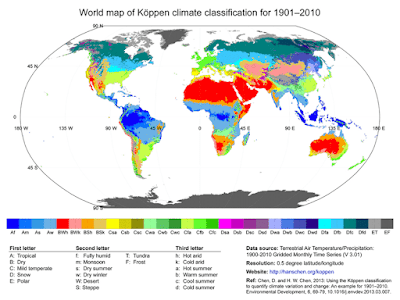
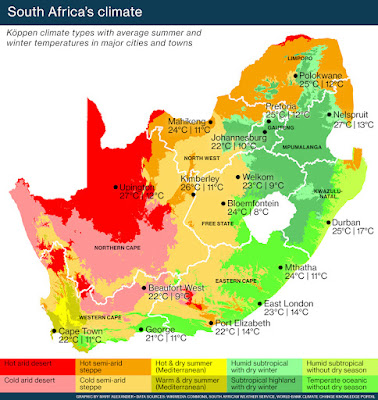
One of the best ways to characterize a region’s climate is through the use of the Köppen Climate Classification which divides the world into regions as a function of their average temperatures, precipitation and seasonal patterns.


In most cases a single zone covers vast areas and multiple countries before slowly transitioning into the next zone, but not so in South Africa. Due to various influences of oceanic currents and an intense topographical relief, thirteen distinct zones can be found across the country making it one of the climatically diverse countries in the world.


In the West cold and hot arid deserts are spanning over the land with the coastal areas being a mix of arid and temperate climates. The further East you move, the more intense the precipitation gets and the desert turns to Steppe and then a large temperate area. Looking over to the coast you find the tallest mountain range in South Africa before the coastal strip in the far East turns into a tropical savannah.

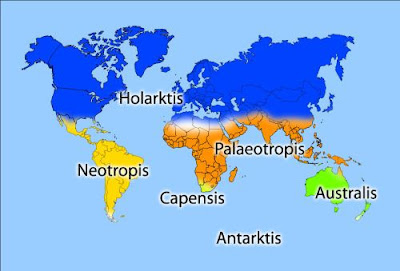
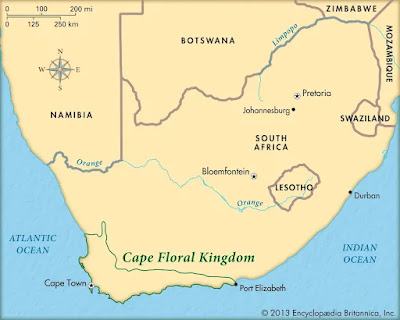
This climatic diversity spanning the entire country together with its climatic isolation being bound by a thick layer of equatorial and desert climates to the North also has created a very unique flora environment. Looking at the global distribution of plants the botanist Ronald Good identified six distinct natural separations of flowering plants which he calls “Floristic Kingdoms”.


Four of these, the Holarktis, Neotropis, Palaeotropis and Australis cover nearly the entire planet, but the flora that developed on the Southern tip of the African continent was determined to be too distinct to be grouped into any of these kingdoms, making it its own, Capensis, or Cape Floral Kingdom.


This relatively small area is not only very different from the rest of the world, but also extremely diverse within itself boasting thousands of different plants many of which is endemic to South Africa. To put some numbers on this, it is estimated that the roughly 200km coastal belt is home to around 9000 species of plants (mostly “Fynbos”), of which around 6000 can only be found here, on par with areas like the Malaysian Tropical Rain Forest or the Amazon. This diversity also constitutes one fifth of all plant species found across the African continent.

A single mountain like the Table Mountain outside Cape Town houses more different plant species than the entirety of the UK. These diverse ecosystems also led to the evolution of an extremely diverse fauna where South Africa joins the ranks of the so called mega- diverse countries in the world each of them boasting over 5000 endemic species. Hundreds of unique mammals, reptiles, amphibian and bird species are unique to South Africa.

The topography too is as diverse as can get. The Southwestern coastal plains are characterized by the Cape fold belt, a series of parallel running mountain ranges. From the steep cliffs of Table Mountain, the mountain ranges continue along the Southern African coastline until Mozambique where the relatively thin coastal plain rises continuously towards the inner continental shelf. The highest region of the great escarpment are the Drakensberg mountains in the South-eastern part of the country. With an elevation of over 3450m resulting in a high Alpine climate similar to the Alps in Europe. The high altitude even brings seasonal snowfall having allowed small ski resorts to operate on the highest peaks of South Africa and Lesotho. The Drakensberg escarpment is an incredible nature spectacle to explore, but the whole range spanning from Cape Town is riddled with spectacular passes. Just behind the towering escarpment the elevated land opens up to form the great African plateau which curves through the inner continent.

Despite being reasonably isolated and remote the area is so incredibly important to human history. It is thought to be the birthplace of Homo-Sapiens. We as humans could not have picked a more fascinating country to start our journey from. If pre-history is your thing, once again Southern Africa is the place to explore.

As a whole, South Africa is a fascinating country with so many geographical stories to tell. From its extremely diverse climate, fascinating mountain ranges and rivers there is something new to learn everywhere.

In most parts of our planet, you have to drive several hundred kilometres just to start seeing a change in your environment, but within a 50km radius from where I sit here typing this article, I can be on beautiful beaches, in lush forests, semi-arid Karoo, climbing mountains or exploring historic passes. Like I said, by pure luck I was born here. How blessed can one be?

Friday, January 2, 2026

Adventure Travel and the search for that Ultimate Journey

 There is a difference between a trip and a journey. A trip has a schedule, a destination, and a predictable arrival time. A journey, however, is what happens when you stop worrying about the destination and start paying attention to the gravel under your tires.

We spend our lives following blue lines on a GPS screen. We’ve become obsessed with the "fastest route" and the "estimated time of arrival." But in the world of adventure travelling, efficiency is the enemy of discovery.

The "Wrong Turn" is where the magic is hidden and where the story actually begins. The atmosphere changes. Suddenly, you aren't just a passenger on a pre-planned route. You are an explorer. Your senses sharpen. You are forced to engage with the topography, the sun's position, and the landmarks around you. You notice the way the light hits a particular ridge, or you find a farm stall that isn't on any map, where the coffee is hot and the conversation is better.

The best memories aren't usually the ones where everything went perfectly. The best stories are found in the detours. The moments remind us why we chose adventure travel in the first place. We didn't buy these machines to follow the crowd. We bought them because they give us the permission to be wrong and the capability to handle the consequences. The type of stories we tell over a braai fire usually begin with a missed signpost, or a moment of "I wonder where this leads."

This year, this is the philosophy we are packing in our panniers. We aren't just looking for the destination. We are looking for the story that happens when the plan falls apart.

The next time you are out on a solo Sunday run and you find yourself staring at a fork in the road that doesn't match your map, take a breath. Don't be so quick to reach for the U-turn. Ride another kilometer. See what is over the next rise.

You might just find that the wrong turn was exactly where you were supposed to be all along.


Sunday, July 14, 2024

The Conclusion

Fast Forward to 2024.

Every year over the December holidays we choose a holiday car. We’ve had bikes, bakkies, SUVs and the like, but in spite of having such fit for purpose vehicles, when we decided to visit Gamkaskloof we did it with a Suzuki Ignis! This started off our Suzuki Adventures and since we have taken a Ignis to the Namakwaland Flowers, the Malgas Pontoon and several other places. We called it the Suzuki Adventures.

This year we had the newly launched Suzuki Fronx. All we needed was an adventure. And all these years, in the back of my mind, I remembered that Kliphuisie next to the river. How can you discover a place like that and not go stay there?

The plan was set, the accommodation booked and paid. To end off our holiday we’d spend three days and two nights on the bank of the Sonderendrivier.


How interesting to drive back on the same roads again, seeing what changed and what stayed the same. The derelict buildings deteriorated quite a bit over time.

And there it was, just as beautiful as all those years ago. I can’t believe it took me this long to come back.


I can't believe it took me this long to come back!


Cosy inside:

Daily visit from the garden service to mow the lawn.


Romantic evenings with no signal. No distractions. True rest.

A stop on the way out next to the same old building where I photographed the GWM H5 all those years ago.

And so, our holiday came to an end. As did the last chapter of the Vaandrigsdrif adventure.

It was time for the lovable Fronx to go back. We really enjoyed our time with this car. There may be much more Suzuki adventures in our future yet.


But for now, it’s back to work. Our first car for the year – the Mercedes A35 AMG. Life is tough when you are a motor journalist!


Tuesday, August 14, 2012

What is in a name?


Well, it's been a while since this little exploration started, but it was not forgotten. And as it happens another opportunity to go explore presented itself at last.

My wheels for today's journey was the aptly named Dodge Journey, a capable 3.6L V6 with enough ground clearance to handle anything today might throw at it. Also note how clean it is... for now.


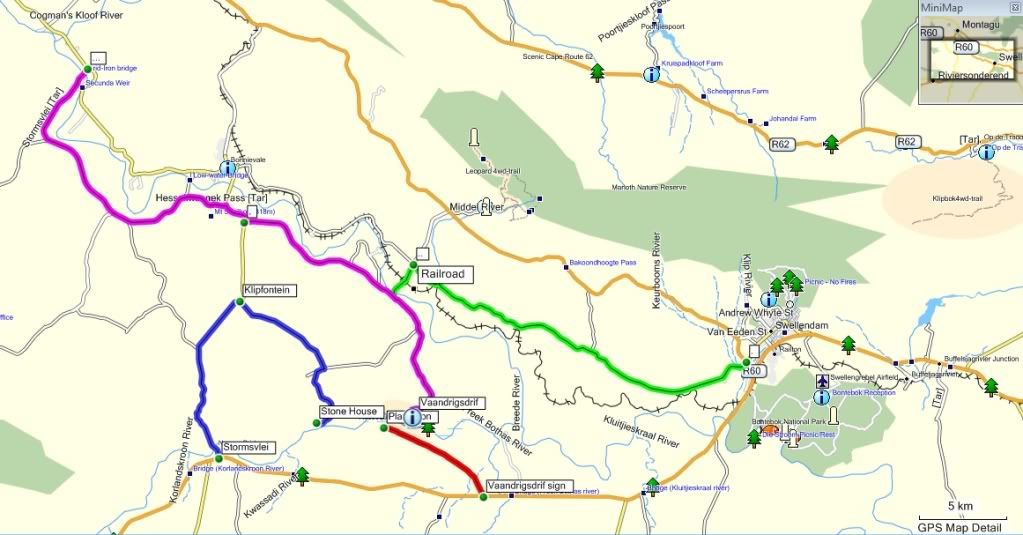
Today I approached the area from a different direction, finding myself North of the Breede River traveling in an Easterly direction. In Beutler's day they would have been traveling East between the Breede and Zonderendriver, so that's where I needed to be. I crossed the Breede River on the R317 towards Stormsvlei, via the Red Iron Bridge:


The Red Iron bridge could easily be mistaken for a train bridge from a distance. It was built in the early 1900's, but apart from that I could not find any meaningful info on it. Structures like these have always fascinated me. Bridges connect people. Bridges provide safe passage over swollen rivers. Bridges allow the adventurer in you to go see what lies on the other side.


And today the Breede River was swollen, overflowing its banks after the recent rain:


The road hugs the Breede River traveling east, and even includes a little pass. It's not spectacular as far as Western Cape passes go, but there you have it - Hessekwasnek Pass:


Soon the road comes to a T-junction and right across you are presented with this:


Now I am pretty sure had Beutler's party come across this all those years ago, they would have stopped, and so did I. Wagon loaded with the newly acquired provisions I hit the road again.

The first gravel - you can see the earth is well and truly drenched at the moment.


Some scenery of the winter landscape:


Once again, I did not have my T4A GPS, so I was merely following my nose with only a general idea of what direction I had to travel in.


Two roads diverged in the Overberg, and I, I took the one less traveled by...


And that has made all the difference!
(with apologies to Robert Frost)


Beginning to move down to the Zonderendriver valley.


The dense row of threes in the distance show where the river runs.


I stopped at the homestead to make my presence known, but no-one was home. I don't like being on some-ones land without permission, but the river was so painstakingly close now. I decided to drive the last couple of 100 meters to the river.


And there it was, overflowing its banks between the trees.


Here wagons had to camp for days waiting for the river to run down. And here I am, on the exact same spot.


The Breede and Zonderend rivers converge mere kilometers from here, with Swellendam being Northeast, and more importantly, North of the Breede river. I wonder why travelers on their way to Swellendam crossed the Zonderendriver to get to the Southern side, only to be confronted by a full Breede River 8km further on? Surely crossing the Breede river higher upstream would have been a better option? I makes little sense to me now, but I am sure they had their reasons back then.

Some more scenery on the way out:


And just as I thought my little adventure was over, I was confronted with the same problem Beutler had! An impassible route due to flooding!


While taking the photo a truck approached, weighed the options of taking the detour, and decided to go for it.


That didn't seem so bad? At least I know the bridge is intact. Should I chance it? Why not?


Well, let me give you some advice. When a road is closed, don't chance it! It's NOT worth it. I drove over the bridge, but the water was much higher / stronger / faster than I anticipated! A wall of water quickly formed next to the car, and I could feel the force of the water trying to push me off the bridge. I made it, through grace. Luckily, I was in a big car with reasonable clearance!

The rest of the journey home was spent looking at the Canola fields in full bloom and reflecting on what I have found.


What is in a name?


Juliet did not attach much importance to it, but in this case, there was more in a name I could have ever imagined. History, exploration, adventure. A name is the link of a place to it's past. I believe in traveling informed. It makes for a much richer travel experience and if you travel informed, a name is where your trip begins. So, Juliet, there is a lot in a name after all! When I first went to see what lay over that hill, some people would only have found a dead end, but because of the name, I now know that I stood where true explorers and adventurers once stood before. And that is very cool.

The last map of my travels:


But the adventure was not over yet...